Table of contents
As global enterprise investment in Generative AI reaches $40 billion, a “GenAI Divide” has emerged: 95% of organizations report no return on investment, while a select 5% of “AI-first” leaders report extracting millions in value and 10–25% EBITDA gains. This analysis synthesizes research from Bain, Google, IBM, Microsoft, and MIT to outline a 12-factor framework for bridging this gap.
The shift from “pilots to profits” requires moving beyond individual productivity tools toward autonomous, memory-enabled, agentic ecosystems architected for scale, governed by trust, and deeply integrated into core business workflows.

The 12 Critical Success Factors
| Pillar 1: Strategy & Governance | Pillar 2: Operating Model | Pillar 3: Adoption & Scaling |
|---|---|---|
| 1. Strategic Alignment | 6. Process Redesign | 10. Employee Adoption |
| 2. Governance | 7. Orchestration | 11. Learning Systems |
| 3. Executive Sponsorship | 8. Data Readiness | 12. Use Case Selection |
| 4. Measurement | 9. Strategic Partnerships | |
| 5. Security & Ethics |
The Voices Behind This Analysis
This article combines industry research with firsthand insights from senior AI engineers, technology executives, and operations leaders actively scaling agentic systems in enterprise environments. The quoted voices span VP-level technology leadership, staff and principal engineers, and GTM and operations specialists responsible for translating AI into P&L impact.
TL;DR – What matters for CTOs & AI Leaders
The data points you should care about
- 95% of enterprises see zero ROI from GenAI investments today (MIT NANDA).
- AI leaders achieve 10–25% EBITDA uplift by scaling agents across core workflows (Bain).
- Production failure rates reach ~95% for custom enterprise AI tools due to orchestration, governance, and adoption gaps (IBM).
- 90% of employees already use AI at work, while only ~40% of companies provide sanctioned tools—creating material security and compliance risk.
- Top-performing organizations realize up to $10 in ROI for every $1 invested, compared with an average of $3.70 (Microsoft).
Why agentic AI ROI is different
- ROI is constrained less by model accuracy and more by interaction overhead, orchestration cost, and learning capability.
- The real inflection point comes when organizations learn to “scale down”—reducing agent time, cost, and supervision through memory, specialization, and process redesign.
The core insight
- You do not “buy” agentic ROI.
- You architect it – through strategy, governance, operating model, and adoption.
What you will learn from this article
After reading, you will be able to:
- Diagnose why pilots fail to convert into ROI
Understand how agent sprawl, task-level automation, and static systems destroy economic value—even with strong models. - Frame ROI correctly for agentic systems
Move beyond token costs and latency to a composite view of Human Time Saved, Net New Capabilities, and Interaction Cost. - Identify the 12 non-negotiable success factors
See how strategy, governance, operating model, and adoption combine into a repeatable ROI framework used by AI-first organizations. - Avoid the most common ROI killers
Including premature ROI evaluation, neglecting post-deployment learning, and focusing on visible front-office demos instead of high-leverage back-office workflows. - Prioritize the right use cases and investments
Learn why the fastest, most defensible returns often come from “quiet” functions like finance, procurement, and risk—where BPO elimination can unlock $2–10M annually. - Translate agentic AI into executive language
Reframe AI initiatives in terms of P&L impact, EBITDA contribution, and operational leverage—rather than innovation theater.
The Strategic Context: Why Agentic ROI Matters Now
The transition from generative experimentation to agentic implementation is driven by a stark economic reality. While global enterprise investment in GenAI has reached $30–40 billion, research from MIT NANDA reveals a sobering “GenAI Divide”: 95% of organizations are currently seeing zero return on these investments. The pressure to move from “pilots to profits” is no longer just a strategic goal; it is a competitive necessity. Bain & Company notes that AI leaders are already delivering 10% to 25% EBITDA gains by scaling agents across core workflows.
The High Cost of Failure
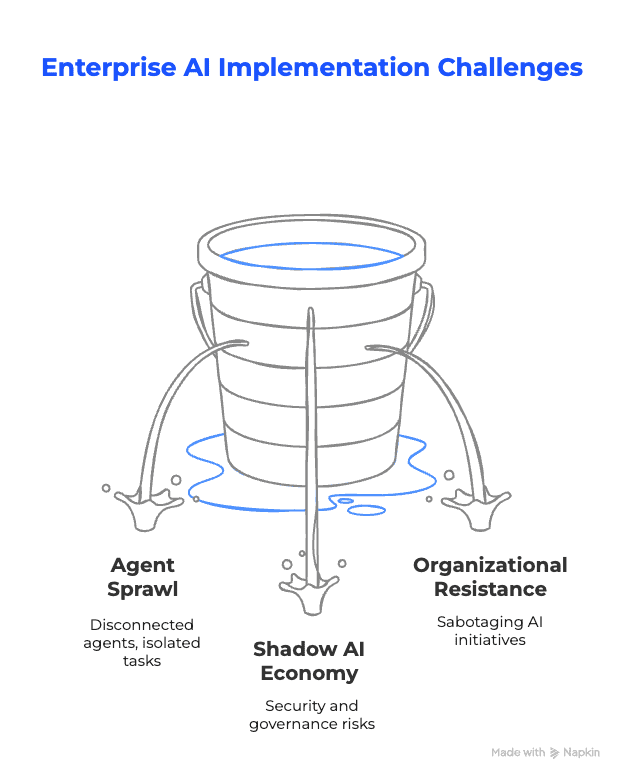
The risk of inaction is matched only by the cost of poor execution. Current failure rates for custom enterprise AI tools reaching production are as high as 95%. Organizations stuck on the wrong side of the divide often suffer from:
- Agent Sprawl and Inefficiency: Deploying disconnected agents for isolated tasks rather than transforming end-to-end workflows.
- The Shadow AI Economy: While only 40% of companies have official LLM subscriptions, 90% of employees report using personal AI tools for work, creating significant security and governance risks.
- Organizational Resistance: According to IBM, 31% of employees admit to actively sabotaging AI initiatives when they feel the technology is “done to them” rather than “built for them.”
Why Agentic ROI is Harder than Classical GenAI
Unlike “classical” GenAI, which often focuses on simple prompt-response interactions for individual productivity, agentic AI introduces greater complexity. Liu et al. (2025) define Agentic ROI not only as a measure of model accuracy but also as a complex trade-off among Information Quality, Human Time savings, and the Interaction Time/Expense required to manage the agent.
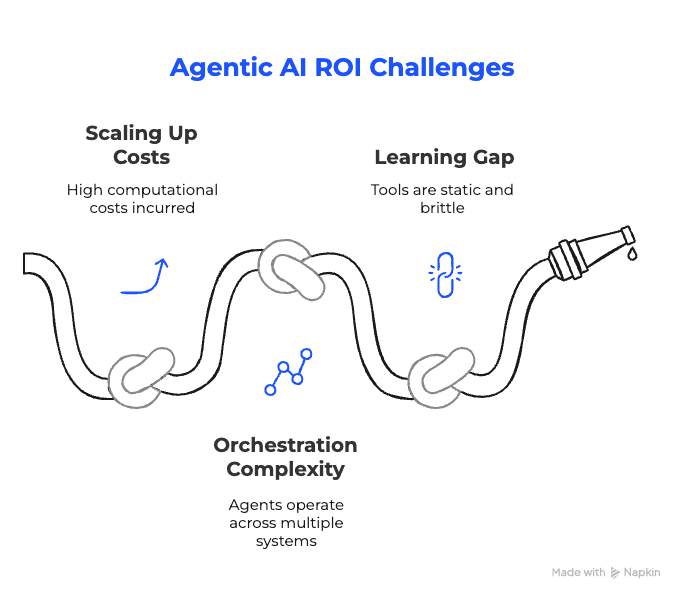
Calculating this return is inherently more difficult because of the “Zigzag Trajectory” of development:
- Scaling Up Phase: Organizations are currently investing heavily in model size and quality, often at the expense of high computational costs and “interaction overhead” (prompt engineering).
- Scaling Down Phase: The real ROI “tipping point” occurs when organizations learn to “scale down”—reducing agent time and financial expense through memory and specialization without degrading information quality.
Furthermore, agentic systems face:
- Orchestration Complexity: Agents must operate across multiple systems, handle manual handoffs, and manage compounding errors in multi-step tasks.
- The Learning Gap: Most current GenAI tools are static; they don’t learn from feedback or adapt to context, making them brittle in dynamic enterprise environments.
The ROI Hypothesis
This context posits a central hypothesis: The strategic implementation of agentic AI represents a critical investment capable of delivering a positive ROI.
However, the validation of this hypothesis is not predetermined. While the potential for value creation is evident, our research indicates that a positive return depends on meeting specific, critical conditions. Success is not an automatic outcome of investment but rather the result of a structured, multi-faceted strategy.
“We have reached a tipping point where the primary challenge is no longer model capability, but economic validation. The 95% failure rate we see in the market isn’t a failure of LLMs, but a failure to bridge the ‘GenAI Divide’ with strategy and memory-enabled systems.”
— Rafal Labedzki PhD, Senior AI Engineering Manager, deepsense.ai
Based on compiled research from industry leaders including IBM, Google, Microsoft, MIT NANDA, and Bain & Company, a clear framework has emerged. Organizations that successfully validate this ROI hypothesis do so by mastering 12 critical success factors. This analysis outlines that framework.
Practical Framework for Measuring and Maximizing ROI
To transition from theory to practice, organizations must adopt a rigorous approach to calculating and monitoring value. According to Microsoft, the fundamental ROI calculation for agentic apps is:
ROI = (Net Return from Investment – Cost of Investment) / Cost of Investment * 100
However, the “Net Return” must account for both Tangible Benefits (cost savings, revenue increase, productivity gains, faster time-to-market) and Intangible Benefits (improved decision-making, brand reputation, employee satisfaction).
Pre-Deployment Readiness: The ROI Checklist
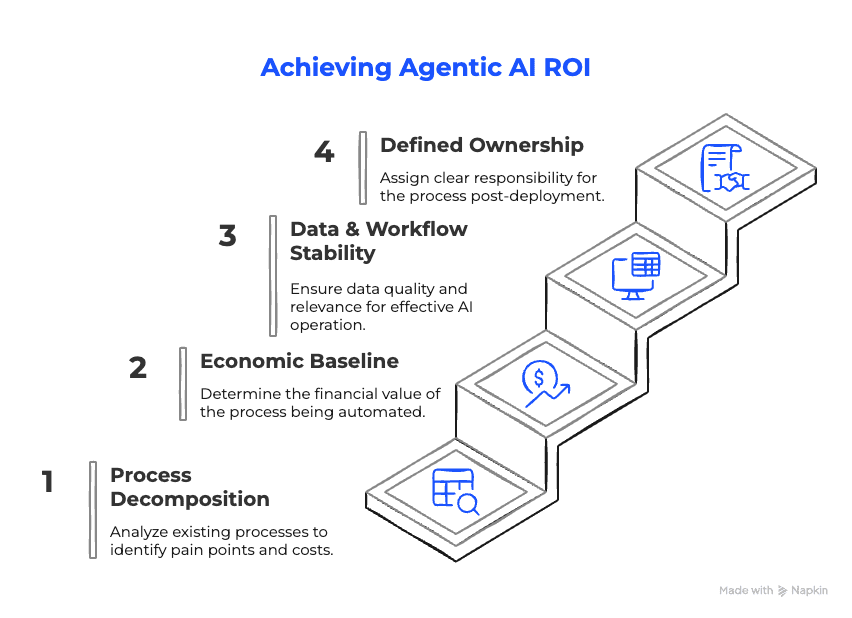
Before deploying any agentic system, organizations should verify the following criteria:
- Process Decomposition: Have you established a clear “before” picture? IBM recommends decomposing processes to identify exactly how long tasks take, what they cost, and where the specific pain points lie.
- Economic Baseline: What is the real financial value of the process being automated? Microsoft highlights that the average AI ROI is $3.70 for every $1 invested, but the highest-performing 5% achieve $10.
- Data & Workflow Stability: Is the data high-quality, relevant, and well-structured? Without contextual knowledge rooted in business logic, agents operate in a vacuum.
- Defined Ownership: Who owns the process post-deployment? Bain & Company emphasizes charging General Managers with ROI targets rather than siloed IT functions.
Common “ROI Killers” to Avoid
- The 14-Month Trap: Impatience can be fatal. IDC/Microsoft research shows that most organizations take 14 months to realize full value. Computing ROI at a single point in time often masks long-term synergistic effects.
- Neglecting Maintenance: Agentic AI is not “set and forget.” Ongoing costs for security patches, performance monitoring, and iterative learning are essential components of the investment base.
- Task-Centric Blindness: Focusing on individual tasks rather than end-to-end transformation leads to “marginal gains” while missing the $2–10 million savings achievable through back-office business process outsourcing (BPO) elimination (MIT NANDA).
The 12 Critical Success Factors Framework
Pillar 1: Strategy & Governance
1. Strategic Alignment
The pursuit of ROI must begin prior to deployment. IBM emphasizes the importance of defining clear ROI goals and relevant KPIs linked to measurable business outcomes (e.g., productivity, revenue, cost savings, satisfaction). This strategy must be inextricably aligned with broader enterprise objectives. Research from Google corroborates this, indicating that a more consistent ROI is observed when leaders actively champion AI in production and secure dedicated budgets for growth.
“Strategic alignment means moving ROI targets from the innovation lab to the General Manager’s desk. Real value is captured in the P&L through redesigned workflows, not just through isolated technical pilots.”
— Michał Iwanowski, VP of Technology & AI Advisory, deepsense.ai
2. Governance
A robust AI governance framework is essential for oversight, risk management, and regulatory compliance. The maturity of this framework directly correlates with the ROI achieved. According to IBM, a significant disparity exists in governance maturity: 68% of “AI-first” organizations with the highest ROI report having mature frameworks, compared with just 32% of other organizations. This framework must encompass metrics for risk, compliance, and transparency to quantify and sustain returns from autonomous systems.
3. Executive Sponsorship
As with any significant organizational transformation, agentic AI requires C-level sponsorship, dedicated budgets, and top-down strategic alignment. This executive commitment is imperative for accelerating adoption and ensuring sustained investment. Google’s research demonstrates this link, showing that among “agentic AI early adopter organizations,” 78% have been leveraging generative AI in production for over one year, a success enabled by strong executive commitment.
4. Measurement
ROI cannot be treated as a single, static calculation. Sustainable success requires continuous, iterative tracking frameworks that encompass not only cost savings but also efficiency gains, revenue impact, employee satisfaction, and strategic enablement. Microsoft describes a model that calculates AI ROI based on a composite of efficiency gains, revenue impact, cost savings, and strategic enablement value, all of which is adjusted for adoption and scale maturity.
5. Security & Ethics
Finally, stakeholder trust serves as the foundation for sustainable ROI. Privacy, security, and transparency must be embedded within the design of AI systems from their inception. Google notes that data privacy and security is the top consideration for companies when evaluating LLM providers. IBM reinforces this, arguing that governance is far more than a compliance checkbox; rather, it is the foundational element of high-quality AI. This level of oversight is what prevents unpredictable agent behavior and ensures regulatory compliance.
Pillar 2: Operating Model
6. Process Redesign
A common pitfall is misapplying AI to isolated task automation rather than to holistic workflow transformation. IBM warns that this narrow focus, rather than a complete end-to-end process transformation, can lead to a chaotic “agent sprawl” that ultimately results in the “opposite of efficiency.” Successful implementation requires integrating agents across end-to-end processes to prevent fragmentation.
7. Orchestration
Organizations must build an orchestration layer to enable integration and interoperability among disparate agents, data sources, and workflows. This layer is critical for ensuring the seamless flow of context across systems. Indeed, IBM states that a failure to orchestrate effectively will likely result in fragmented efforts and diluted returns. Emerging frameworks, such as the Model Context Protocol (MCP) and Agent-to-Agent (A2A), are being developed to address this coordination challenge.
8. Data Readiness
Agentic AI systems are fundamentally dependent on high-quality, contextual data to execute autonomous decisions. Consequently, investment in a unified, high-integrity data infrastructure is a non-negotiable prerequisite. As IBM notes, such initiatives are likely to fail when data is poorly structured or remains fragmented in organizational silos.
9. Strategic Partnerships
Few organizations possess the requisite, comprehensive expertise to succeed in isolation. The optimal strategy often involves combining internal capabilities with external AI expertise. Co-developing tailored solutions with trusted vendors and integrators is key. MIT NANDA’s research found that pilots built through strategic partnerships were twice as likely to reach full deployment as purely internal efforts.
Pillar 3: Adoption & Scaling
10. Employee Adoption
Technological implementation constitutes only one part of the equation; cultural adoption is the other. Leadership must actively upskill and engage the workforce, fostering “AI ambassadors” to co-create value. IBM advises executives to rally their employees, transforming them into internal champions, and to incentivize those who embrace the technology, thereby converting organizational skepticism into broad support.
In Practice: To drive internal adoption, IBM launched the “watsonx Challenge,” an annual event that saw 167,000 employees submit over 15,000 AI solutions, turning potential “saboteurs” into active creators of the new workflow.
“Leadership must stop treating AI as a productivity tool for individuals and start treating it as a platform for cultural transformation. Success is measured by how many employees you turn from skeptics into active ambassadors of the new workflow.”
— Rafal Labedzki PhD, Senior AI Engineering Manager, deepsense.ai
11. Learning Systems & Crossing the “GenAI Divide”
A critical concept highlighted by MIT NANDA is the “GenAI Divide”—the gap between organizations that merely use generative AI and those that achieve genuine transformation. Crossing this divide is contingent on building adaptive learning systems. According to MIT NANDA, successful agentic AI is engineered with persistent memory and iterative learning capabilities by design, which directly addresses the “learning gap” that traps organizations on the wrong side of this divide.
“Truly agentic AI demands long-term memory – semantic to understand, episodic to recall, and procedural to adapt – transforming it from a static tool into a continuously learning partner.” — Mateusz Wosiński, Senior ML Tech Lead, deepsense.ai
This signifies that the most valuable systems are not static but are “memory-enabled.” They are engineered to learn from user feedback, retain context, and, as IBM notes, to autonomously adapt to changing workflows and environments. This capacity for continuous adaptation distinguishes a basic tool from a transformative agent.
12. Use Case Selection
It is strategically crucial to prioritize applications with high-impact and high-ROI potential, such as customer experience, finance, or cybersecurity, before attempting broader enterprise-wide expansion. MIT NANDA observes that back-office automation often yields a superior ROI, delivering faster payback periods and more quantifiable cost reductions.
In Practice: While 70% of AI budgets are typically allocated to high-visibility areas like Sales & Marketing, MIT NANDA finds that the most dramatic “hidden” ROI often comes from back-office BPO elimination, where organizations save $2–10 million annually in document processing and risk management.
Conclusion: Beyond Agents to the Agentic Web
In conclusion, achieving a positive ROI from agentic AI is not contingent on technology alone but on a comprehensive, strategic approach. The 12 critical factors analyzed—ranging from executive alignment and governance to employee adoption and continuous measurement—constitute the necessary conditions for validating the hypothesis.
The transition from experimentation to a scaled, ROI-positive agentic enterprise is not a technological challenge, but an organizational one. Realizing tangible value requires a synthesis of strategic alignment, operational readiness, and cultural adoption. Success lies in the holistic mastery of the 12 critical success factors framework, turning the potential of agentic AI into a sustainable competitive advantage.
References
This analysis is based on insights synthesized from the following industry reports and research papers:
- MIT NANDA: “The GenAI Divide: STATE OF AI IN BUSINESS 2025.”
- Bain & Company: “State of the Art of Agentic AI Transformation | Technology Report 2025.”
- Google: “The ROI of AI 2025: How agents are unlocking the next wave of AI-driven business value.”
- IBM: “Start realizing ROI: A practical guide to agentic AI” and “How business leaders can realize ROI with AI Agents.”
- Liu et al. (2025): “The Real Barrier to LLM Agent Usability is Agentic ROI.” (arXiv:2505.17767).
- Microsoft: “A Framework for Calculating ROI for Agentic AI Apps.”
Table of contents