Table of contents
Healthcare organizations face a fundamental challenge: while AI promises to transform patient care and accelerate drug discovery, deploying these systems in production remains complex due to strict regulatory requirements. This challenge is no longer theoretical—through our work as an Anthropic partner, building and operating Model Context Protocol (MCP) connectors used in live Claude deployments across healthcare and life sciences, we see firsthand what breaks when AI moves from experimentation to regulated production.
Most organizations see MCP deployment as a simple API Integration. However, in regulated industries, the 90% below the surface represents a potential “compliance nightmare”. While consumer apps iterate rapidly, healthcare systems face millions in HIPAA violation costs and months of FDA documentation. Traditional centralized models and broad permissions are incompatible with the strict data sensitivity and workflow complexity required for patient safety.
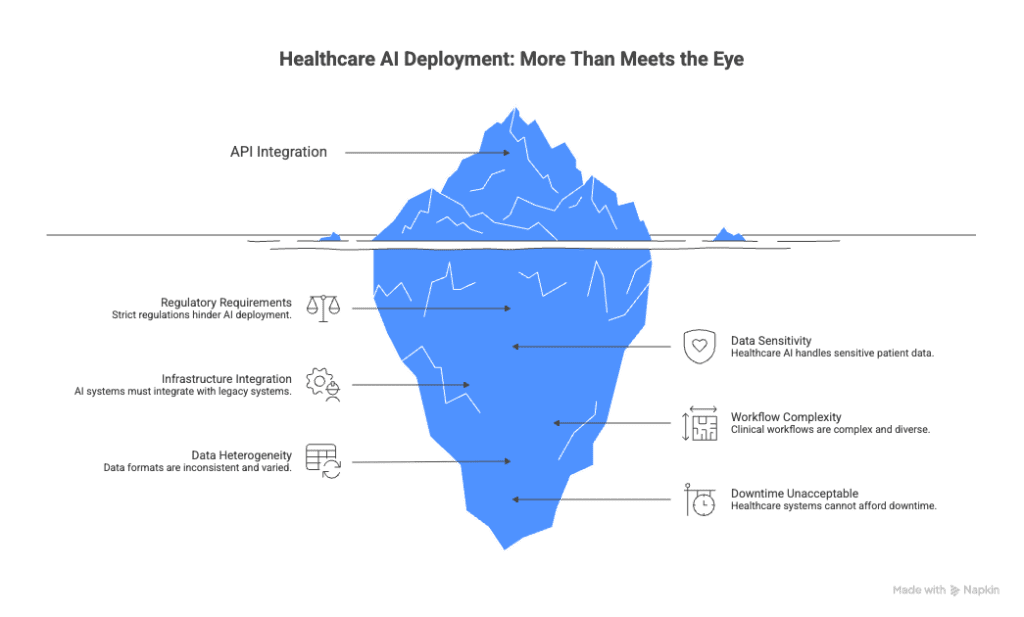
Healthcare AI systems must handle the most sensitive data types while integrating with legacy EHRs, LIMS, and research platforms. They need explainable decisions for clinical workflows and comprehensive audit trails for regulatory inspections. Most importantly, they can never compromise patient safety or data privacy.
Beyond compliance, there’s the practical challenge of making AI systems work within existing healthcare infrastructure. Clinical workflows are complex, data formats are heterogeneous, and downtime isn’t an option. Traditional AI integrations often require extensive custom development, creating maintenance nightmares and vendor lock-in.
MCP acts as a secure, standardized gateway that allows AI to “see” regulated data without ever compromising the underlying security boundary.
TL;DR — What You’ll Learn from This Article
- Why MCPs are not “just API integrations” in regulated industries
In healthcare and life sciences, the majority of complexity lies below the surface: compliance, auditability, access control, and provability under regulatory scrutiny. - Why traditional “move fast” AI architectures fail under HIPAA, FDA, and GxP
Regulatory requirements fundamentally shape system design; they cannot be retrofitted onto unconstrained LLM or centralized integration patterns. - A real-world case study of MCPs at enterprise healthcare scale
Lessons from building and operating MCP servers for public life sciences datasets (ICD-10, ClinicalTrials.gov, bioRxiv, ChEMBL) used in live Claude deployments. - How to balance compliance with performance and cost
Practical techniques like stateless design, intelligent caching, observability without PII retention, and explainable error handling. - Why compliance can be a competitive advantage, not just a constraint
Organizations that architect MCPs correctly can move faster in production—with lower risk, less rework, and stronger regulatory confidence.
Our MCP and Integration Experience at deepsense.ai
At deepsense.ai, we’ve spent years working at this intersection of AI innovation and regulatory compliance. As highlighted in Anthropic’s recent healthcare announcement, we’ve helped organizations navigate these challenges through specialized AI implementations in healthcare and life sciences.
Our production deployments have taught us that success requires more than adapting existing tools – it demands rethinking how AI systems are architected from the ground up for regulated environments. But success starts with understanding exactly what “regulatory compliance” means in practice. The regulatory landscape isn’t just about following rules; it’s about building systems that can prove their compliance under scrutiny.
Healthcare AI Compliance: Navigating HIPAA, FDA, and GxP Requirements
When we talk about “regulatory compliance” in healthcare AI, we’re not dealing with a single checklist. Instead, we’re navigating a complex web of overlapping frameworks, each with different focuses and requirements. Here is “The Big Three” of compliance:
The Big Three: Navigating the HIPAA, FDA, and GxP Compliance
| Framework | Compliance Impact | Key AI Requirements |
| HIPAA (Health Insurance Portability and Accountability Act) | Every patient data interaction must be logged and traceable | • Comprehensive access controls• Complete audit trails• End-to-end encryption• Data breach notification protocols |
| FDA | Extensive validation and continuous monitoring for AI that impacts patient care | • Software as Medical Device (SaMD) validation• Risk assessment documentation• Ongoing performance monitoring• Clinical evidence requirements |
| GxP standards (Good Practice guidelines) | All software in drug development pipeline must meet validation standards | • Data integrity validation• Software qualification protocols• Change control procedures• Electronic signature compliance |
Here’s what many organizations miss: these aren’t just policy requirements you can bolt onto existing systems. They fundamentally shape how your AI architecture must be designed from the ground up.
The challenge isn’t meeting any single requirement in isolation. It’s building systems that satisfy all these overlapping demands while remaining performant, maintainable, and scalable. This is where traditional AI architectures break down, and why we need fundamentally different approaches.
Secure MCP Architecture Design for Healthcare and Life Sciences
After years of building compliant AI systems, we’ve learned that successful healthcare AI architecture isn’t about adding security layers to existing patterns – it’s about rethinking the entire system design around compliance-first principles.
While MCP servers are fundamentally connectors between LLMs and APIs, in regulated environments, these connections become critical security and compliance boundaries. The challenge isn’t just about AI – it’s about creating secure, auditable pathways between powerful language models and highly sensitive healthcare data systems.
Essential Design Principles for Healthcare MCP Servers
The foundation of any regulatory-compliant MCP architecture rests on four key principles:
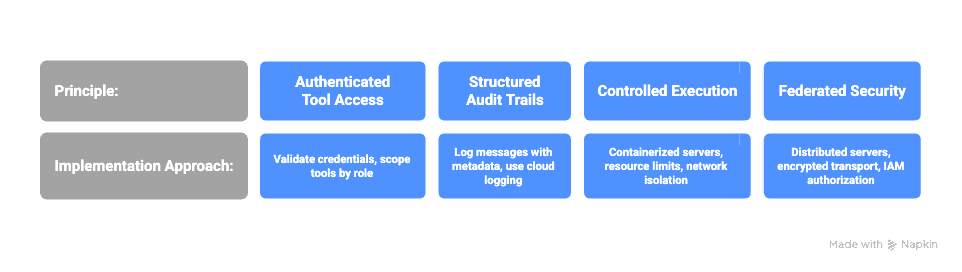
Building MCP servers for healthcare leverages the protocol’s client-server architecture to create natural security boundaries. Each MCP server runs as an isolated process, communicating with Claude through standardized JSON-RPC messages over stdio or HTTP. For healthcare deployments, we extend this isolation by containerizing each server with strict resource limits and network policies.
The MCP protocol’s structured message format becomes essential for compliance. Every tool invocation follows the “tools/call” request-response pattern, providing consistent audit points. Healthcare MCP servers must log complete message payloads—including tool names, parameters, and responses—with timestamps and user context for regulatory reporting.
MCP’s capability negotiation through “initialize” and “tools/list” endpoints enables dynamic access control. Healthcare servers can advertise different tools based on authenticated user roles, ensuring clinicians see patient care tools while researchers access only anonymized datasets.
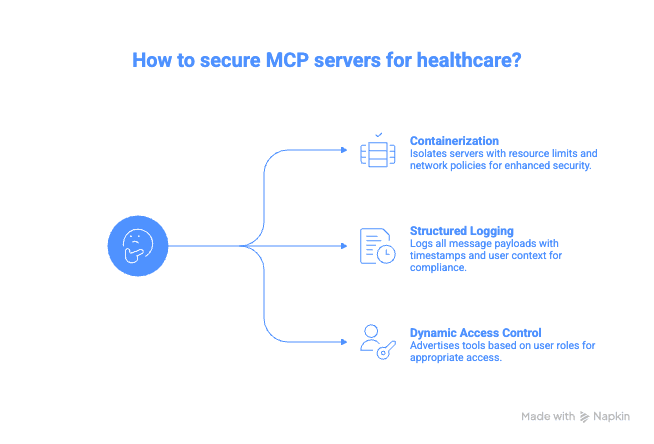
This protocol-aware approach to healthcare security creates the foundation for production deployments that satisfy both technical requirements and regulatory compliance, as demonstrated in our next section’s case study.
Case Study: The Healthcare & Life Sciences MCP Suite
When Anthropic announced its expanded healthcare and life sciences capabilities in January 2025, deepsense.ai played a key role as the specialized partner building the MCP infrastructure that powers these integrations. Our work developing MCP servers for CMS Coverage, bioRxiv, ChEMBL, ClinicalTrials.gov, ICD-10, and the NPI Registry provided real-world validation of the architectural principles we’ve outlined.
The Challenge: Public Health Data at Enterprise Scale
Unlike typical enterprise integrations, healthcare MCP servers must handle massive public datasets while maintaining enterprise-grade security and compliance. The ICD-10 database contains over 70,000 diagnosis codes, while ClinicalTrials.gov indexes hundreds of thousands of studies. These systems require different security models than patient data – the information is public, but the access patterns and integration points must still meet healthcare security standards.
Our AWS Implementation Architecture
To address these enterprise-scale challenges while ensuring HIPAA-level isolation, we designed a cloud-native foundation on AWS. Our architecture prioritizes “defense-in-depth”, ensuring that every data request is isolated, encrypted, and recorded.
Container Orchestration: Each MCP server runs as an isolated task Amazon ECS Fargate service. We use separate task definitions for each data source (bioRxiv, ChEMBL, etc.), allowing independent scaling and updates without cross-contamination.
Network Security: All containers operate within private subnets with carefully configured security groups that restrict inbound traffic to specific ports and authorized sources, while all data transmission uses TLS encryption in transit by default.
Observability and Compliance: We use CloudWatch to store metrics related to servers performance, traffic, infrastructure uptime and resources consumption. Any metrics that exceed configured threshold immediately triggers CloudWatch alarm. What we do not store is any kind of user requests or responses data – therefore no PII data is ever stored in our environment.
While this infrastructure provides a secure environment for the MCP servers, security alone isn’t enough for a production environment. We also had to provide reasonable performance of servers, while maintaining its relatively low complexity and costs.
Production Secrets: Balancing Latency with Data Integrity
In life sciences, a secure system that is too slow to use is a failed system. To bridge the gap between rigorous security protocols and the need for fast responses, we implemented several capabilities to enable that.
Performance Caching: ElastiCache Redis clusters cache frequently accessed public data like ICD-10 codes and clinical trial metadata. This reduces API call latency by up to 80% for common queries while ensuring data freshness through TTL-based invalidation.
Stateless Design: Our MCP servers maintain no local persistent state beyond caching. Each tool invocation processes requests independently, simplifying horizontal scaling and eliminating data consistency concerns across container instances.
Monitoring Critical Metrics: CloudWatch dashboards track API availability for each data source, cache hit ratios, and request volume patterns. Custom alarms notify on service degradation or unusual access patterns that might indicate issues.
Error Handling: Instead of exposing raw API error responses, our MCP tools return meaningful, explainable reasons when requests fail. This approach protects against information leakage while providing Claude with actionable feedback that can be communicated clearly to end users.
By balancing these performance gains with a strictly stateless design, we achieved a system that is both highly responsive and inherently auditable. This dual success paved the way for the significant technical wins observed in our deployment on AWS. The combination of containerized isolation, comprehensive logging, and intelligent caching proved essential for handling the scale and reliability requirements of production healthcare AI systems.
The Bottom Line: Compliance as a Competitive Moat
Building MCP servers for regulated industries isn’t just about adapting existing patterns – it requires rethinking AI infrastructure from the ground up with compliance as a core architectural principle.
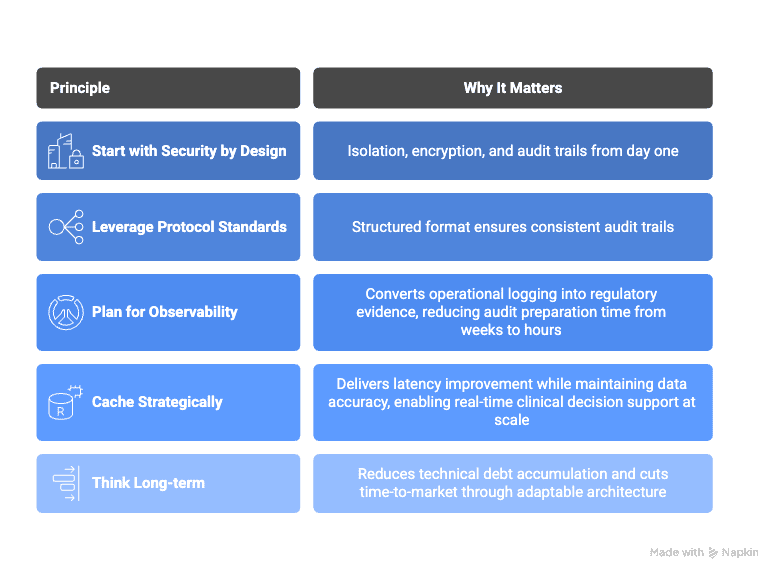
The healthcare AI transformation is happening now. Organizations that master compliant MCP deployment will gain significant competitive advantages in bringing AI-powered solutions to market faster and more securely than their competitors. The question isn’t whether to build these systems, but whether you have the expertise to build them right.
At deepsense.ai, our production experience with Anthropic’s healthcare platform proves that compliant, enterprise-grade MCP infrastructure is not just possible – it’s a competitive necessity for the future of healthcare AI.
Enterprise-Ready Anthropic Service Partner

Table of contents