Table of contents
In every conversation with technical leaders this year, a familiar pattern emerged. Companies were racing to adopt LLMs, but the public narrative rarely matched what technical teams were experiencing internally. Benchmarks, model releases, and bold claims filled the airwaves. Reliable insight into what happens after early demos — inside deployed systems — was largely absent.
So we asked a straightforward question:
Where are the numbers, the blockers, and the lessons reported by teams shipping LLM systems at scale?
Not anecdotal, but grounded in repeatable patterns. Not general, regarding every industry, B2B or B2C, SaaS or Professional Services?
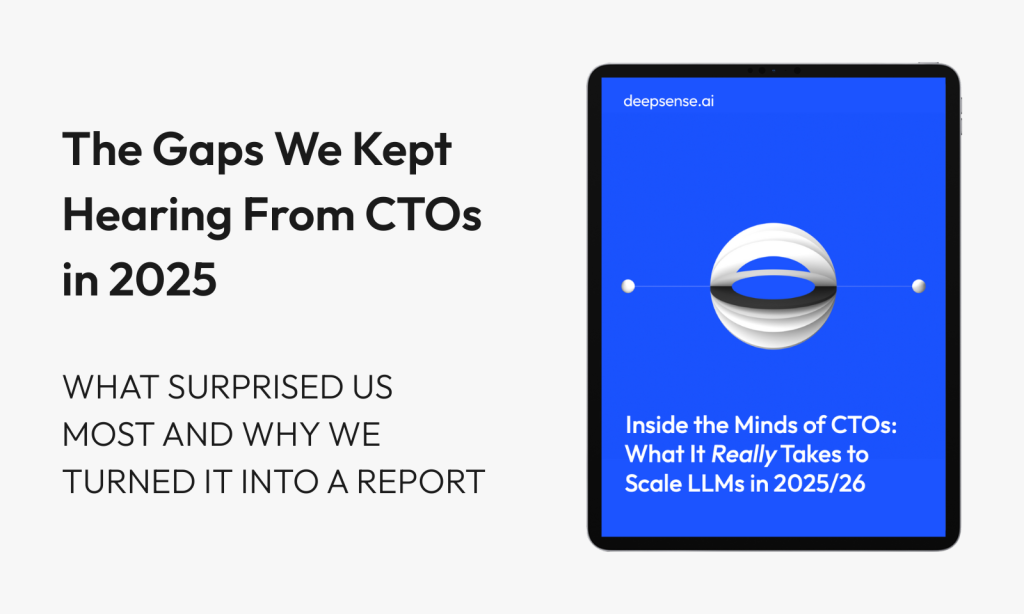
When we couldn’t find a source that cut through the noise, we created one.
If you want to see how other CTOs are approaching LLM adoption today, explore the full Enterprise LLM Adoption Report here.
Why We Built This Enterprise LLM Report: Gaps in How AI Adoption Is Measured
CTOs today face a paradox. The AI ecosystem is one of the fastest-moving technology landscapes in history, yet the information surrounding LLM adoption is fragmented, inconsistent, or shaped by vendor incentives rather than deployment constraints.
Three gaps kept coming up in conversations with technical leaders:
1. Too much hype, too little signal
Public metrics make LLMs look flawless. But the questions CTOs wrestle with — latency, context updating, integration complexity, governance — rarely surface in mainstream reports. As one chapter notes, “The AI isn’t broken. The plumbing is where the work is.”
2. Most reports rely on surface-level surveys
Large sample sizes often come from lightweight questionnaires that don’t measure operational depth. Leaders told us they didn’t need another “n = 500” slide deck built on shallow prompts. They needed insight from people solving the same infrastructure, compliance, and adoption challenges they face.
3. The missing perspective: applied AI
Our team spends every week inside enterprise deployments — from healthcare and telecom to pharma and SaaS. We see where systems fail, where they scale, and what drives ROI in practice. We wanted a dataset that reflected this reality across organizations, not just individual projects.
This report is the answer: a grounded look at LLM adoption created for — and informed by — the technical leaders responsible for deploying and operating AI systems in enterprise environments.
How This LLM Adoption Report Was Built: CTO Interviews and Applied AI Methodology
From April to July 2025, we interviewed 20 seasoned AI leaders from global enterprises and high-growth tech companies. This wasn’t a mass-market poll. It was a deep research exercise combining:
- Structured quantitative questions (budgets, use cases, model strategies, infrastructure blockers)
- Long-form qualitative responses that captured lived operational experience
- Cross-industry representation spanning tech, telecom, pharma, healthcare, manufacturing, and professional services
- Technical validation and interpretation by our AI advisory team
Several respondents agreed to be named, including executives from Brainly, B-Yond, Coleman, Data Octopus, 4see, and ReSpo-Vision. Others participated under NDA due to sensitive data and regulated workloads.
The analytical backbone of this report was shaped by deepsense.ai’s senior technical leadership.
Artur Zygadło, LLM Technical Lead and OpenAI Tech Champion at deepsense.ai, led the technical review and validation of the dataset. His work focused on verifying architectural patterns, stress-testing conclusions against deployed enterprise systems, and ensuring that the insights accurately reflect LLM systems already in production.
The broader group of senior engineering leads at deepsense.ai contributed additional technical perspective, cross-checking findings against ongoing enterprise projects across regulated and high-scale environments.
Michał Iwanowski, VP of Technology & AI Advisory, acted as the integrator of the report — connecting individual findings into a coherent narrative, identifying cross-cutting trends, and anchoring conclusions in long-term applied AI strategy.
The result is a report grounded in observed engineering constraints and architectural decisions.
Why 20 CTO Interviews Reveal More About Enterprise LLM Adoption Than Large Surveys
In consumer research, bigger is better. In applied AI research, depth beats volume.
Our 20 respondents are decision-makers responsible for budgets, systems, and teams — not anonymous survey participants clicking through multiple-choice questions. According to the report:
- 70% are CTOs, Chief AI Officers, or Heads of AI
- 85% have deep hands-on AI/ML experience
- 35% manage $1M+ annual AI budgets, with several exceeding $10M
- They operate in organizations ranging from 100 to 10,000+ employees
These are people evaluating agent architectures, renegotiating GPU capacity, navigating GDPR compliance, and answering directly for system performance in production environments.
Their answers weren’t opinions — they were operational insights shaped by operational constraints, end users, and deployed systems.
This type of dataset can’t scale to 200 respondents without losing what makes it valuable: depth, nuance, and technical candor.
The full report shows how these patterns compare across industries, budgets, and organizational maturity levels. See where other enterprise teams stand.
What Enterprise CTOs Can Learn from This LLM Adoption Dataset
For CTOs, VPs of Engineering, and AI Directors, this report provides access to a peer group that rarely shares operational detail publicly.
The respondents’ environments mirror what large enterprises face:
- Complex infrastructure and legacy systems
- Strict compliance regimes such as GDPR and HIPAA
- High-stakes workflows in healthcare, telecom, and manufacturing
- Large user bases where small errors compound into operational and compliance risk
- Multimodal, multi-LLM, and agentic systems under active development
These conditions shape the future of LLM adoption far more than benchmarks or demo showcases.
If your team is planning or scaling LLM deployments, these leaders are your closest reference group — technically, organizationally, and operationally.
Key Findings: What CTOs Say About Scaling LLMs in Production
The findings challenge several widely held assumptions. A few standout insights:
1. Infrastructure — not model accuracy — is the biggest blocker
Teams pointed to latency, integration complexity, context updating, and orchestration challenges long before mentioning hallucinations.
2. Budgets don’t predict maturity
Some organizations with < $100K annual budgets were already deploying copilots and support agents, while others with $5M+ struggled with adoption and trust.
3. The top investment themes: RAG, agents, and internal AI assistants
These reflect a shift from model-centric thinking to system-centric architectures.
4. LLMs are already embedded in core workflows
Knowledge management (75%), customer support automation (70%), and document analysis/reporting (65%) dominate enterprise deployments.
5. Domain-customized LLMs are becoming non-negotiable
45% said domain-specific adaptation is “critical” or “very important.”
6. Multimodal adoption is accelerating faster than expected
60% are experimenting with or already using multimodal models.
7. Organizational friction is often a larger barrier than technical limitations
Respondents cited workflow resistance, lack of imagination, and trust issues.
8. Security and compliance remain the ultimate gatekeepers
Especially in healthcare, legal, telecom, and public-sector environments.
Across respondents, adoption barriers consistently clustered around organizational trust, integration complexity, and security constraints.
Top Themes Identified
| Obstacle Category | Sample Mentions |
| Lack of Trust in AI Outputs | “Employees don’t trust LLM results in legal or compliance settings”; “Caution in relying on LLM-generated outputs”; |
| Data Privacy,GDPR & Security | “Clients fear data leakage”; “Privacy/GDPR constraints”; “Model privacy in health data”; “Edge device limitations” |
| Internal Resistance to Change | “People can’t imagine AI doing their work”; “People think their way is the only way” |
| Tooling and Validation Infrastructure | “Good tools for streamlining output validation are missing”; “They don’t know audiology or acoustics. We’d need heavy fine-tuning for our medical devices.” |
| IT Constraints and Legacy Systems | “IT security concerns”; “Embedding LLMs into regulated devices is non-trivial” |
| Resourcing & Budget | “Funding”; “No free time to work on implementation” |
Want to see the full data behind these insights?
The complete report includes detailed charts, percentages, and survey results across industries, budgets, and organizational maturity levels. Explore the full Enterprise LLM Adoption Report.
What These Findings Mean for Companies Planning Enterprise LLM Adoption
If your team is building or scaling LLM systems, this report provides early visibility into what your next 12–24 months may look like.
Expect integration and governance to matter more than model selection.
The findings show that the decisive factors for success sit in orchestration, RAG quality, agent reliability, observability, and data architecture.
Plan for organizational change early.
Multiple respondents reported that the biggest blocker wasn’t the model — it was internal trust, workflow change, and responsibility boundaries.
Invest in repeatable systems, not isolated PoCs.
Leaders are shifting from “try the new model” to building AI systems designed for reliability, traceability, and scale.
Prioritize domain customization where accuracy and trust are essential.
Generic models are a starting point. Systems used in enterprise environments demand grounding in internal knowledge, context, and constraints.
Recognize that applied AI is a marathon.
As one respondent noted, deployment isn’t the finish line — it’s the beginning of a new class of challenges.
What Leaders Would Build If Nothing Held Them Back
| Theme | Examples |
| Hardware + Infrastructure Upgrades | “Provide more powerful infrastructure to use bigger models”; “Set up own AI servers with open-weight LLMs” |
| Personal LLM Devices & Agents | “Manufacture handheld LLM assistant with voice + full access to personal files and web”; “Rewrite our apps so users can talk to them in natural language” |
| Scaling Teams | “Increase team building AI agents”; “Run multi-LLM experiments and validation at scale” |
| Data Integration | “Extend data sources”; “Integrate speech, hearing, and health biomarkers for richer personalization” |
| Research Investment | “Expand multimodal AI research” |
Download the Full Enterprise LLM Adoption Report (2025/26)
If you want the complete dataset, charts, direct quotes, and strategic patterns shaping enterprise LLM adoption in 2025/26, you can access the full report here:
👉 Download the complete report on scaling LLMs in enterprise environments
If you’d like to discuss how these findings map to your AI roadmap, our team is always open to a conversation.
Acknowledgements
This report would not exist without the openness and expertise of the 20 AI leaders who shared their experience — including executives from Brainly, B-Yond, Coleman Research, ASEE, Data Octopus, and ReSpo Vision — as well as contributors participating under NDA across healthcare, telecom, pharma, manufacturing, and enterprise software.
The project team at deepsense.ai — researchers, engineers, analysts, and advisors — dedicated months to ensuring the dataset reflects observed deployment patterns rather than assumptions.
Thank you for helping elevate the conversation around LLM adoption with clarity, candor, and technical depth.
Table of contents