
Production AI for Financial Services
We help insurers, investment organizations, and regulated financial institutions design, build, and scale AI systems across document-heavy operations, research, decision support, and risk workflows.









AI That Works Across Existing Financial Systems
We integrate AI into existing policy, claims, core banking, portfolio, CRM, and document workflows—working around legacy constraints rather than forcing a core-system transformation. We use APIs and connectors where possible, deterministic logic where reliability matters, and controlled UI automation only when no better integration path exists.
Where We Create Value in Financial Services

Insurance Operations and Claims Automation
Automate high-volume insurance intake, document processing, classification, routing, and case preparation across emails, attachments, and existing operational systems.
Our capabilities
- Customer and claims intake automation
- Email and document classification
- Data extraction and validation
- Claims triage and routing
- Case preparation for human review
- Human-in-the-loop exception handling
- Audit trails and secure deployment
Underwriting and Evidence-Backed Decision Support
Turn submissions, financial documents, internal rules, and external data into validated, source-linked decision packs – while keeping expert judgment and final decisions with your teams.
Our capabilities
- Submission and application intake
- Document extraction and normalization
- Missing-information and inconsistency detection
- Integration with internal and external data
- Evidence-backed risk summaries
- Decision memo generation
- Source citations and approval workflows


Investment Research and Financial Intelligence
Help investment and strategy teams analyze more sources, shorten research cycles, and produce traceable insights grounded in internal and external financial data.
Our capabilities
- AI investment research agents
- Multi-source data ingestion
- RAG for financial documents and research
- Source-grounded analysis
- Competitive and market intelligence
- Scenario and portfolio analysis foundations
- Report and decision-pack generation
Risk, Fraud and Market Monitoring
Build AI systems that identify suspicious patterns, monitor external signals, and help investigators and risk teams prioritize cases more efficiently.
Our capabilities
- Fraud and anomaly detection
- Market and social signal monitoring
- Alert classification and prioritization
- NLP-based risk analysis
- Investigation dashboards
- Competitive and regulatory intelligence
- Predictive analytics

Official AI and Cloud Partners
We work closely with leading model, cloud and AI infrastructure providers to help clients move faster from technology selection to reliable production deployment. These partnerships strengthen our platform expertise, implementation capabilities and ability to support complex enterprise environments across the full AI delivery lifecycle.






Built for Financial Services Environments Where Reliability and Control Matter
Our AI State-of-the-Practice
AI Value Creation Guidance and Advisory

project
Helping Private Equity Turn AI Opportunities Into Scalable Value-Creation Roadmaps
We proposed an AI Product Accelerator model combining AI advisory, product strategy, and implementation planning. The approach started with discovery workshops, stakeholder…
project
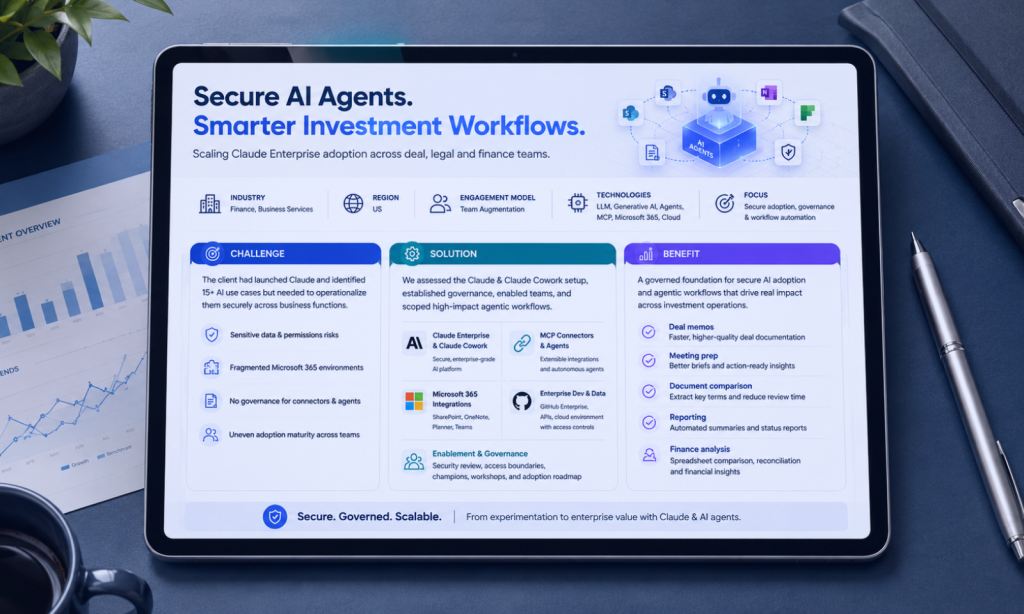
Agentic AI for Investment Workflows. Securely Scaling Claude Across Deal, Legal, and Finance Teams
We assessed the Claude Enterprise and Claude Cowork setup, reviewed security settings, access boundaries, connector risks, and configuration gaps, then created…

project
Investment Research Agent for an AI-Native Portfolio Management Platform
The scalable foundation can be extended with additional capabilities such as scenario stress testing, portfolio strategy optimization, or portfolio rebalancing.
project
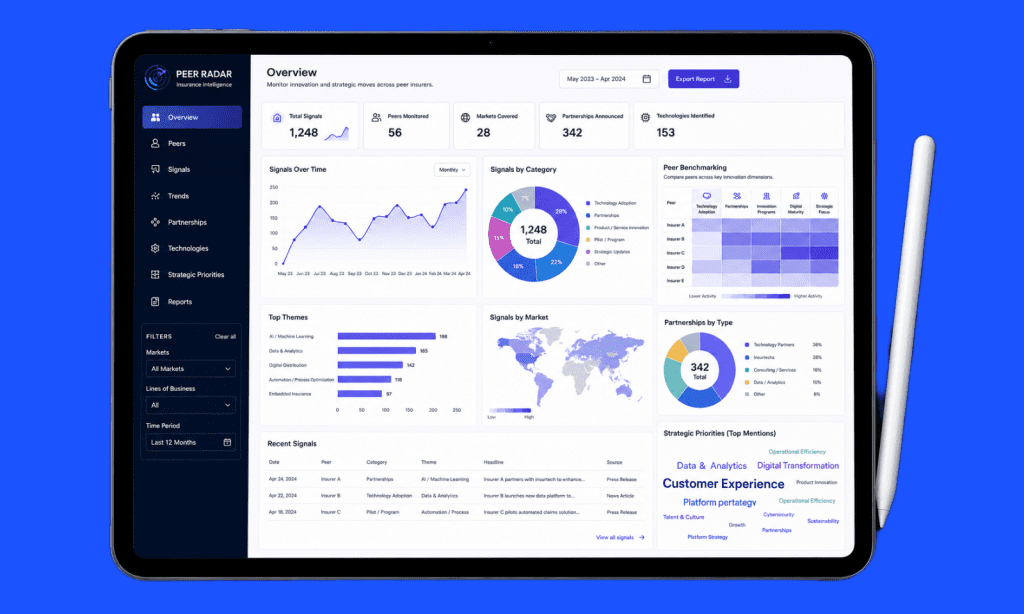
Competitive Intelligence for Structured Tracking of Insurance Innovation
Instead of manually reviewing large volumes of data sources, stakeholders could quickly identify relevant innovation signals, compare competitors across selected dimensions, and…


case-study
Cutting Response Time by 95% in Customer Service
The Proof of Concept demonstrated that AI can process thousands of customer emails daily with high accuracy, reducing handling time from minutes…

project
Streamlining Data Processing with Ray Infrastructure Optimization
The client adopted our recommendation to transition to the Anyscale Platform, reducing internal tooling maintenance and improving Ray adoption.

project
Stock Market Fraud Prevention with AI-Powered Detection
We developed a web monitoring system that analyzes investment-related social media, forums, and message boards.
From Priority Use Case to Production Deployment

Opportunity and KPI Definition
Identify workflows where AI has executive sponsorship, measurable operational value, accessible data, and a credible path to deployment.
Architecture and Risk Design
Define data flows, integrations, model strategy, permissions, evaluation criteria, human controls, and deployment requirements.
Validation with Real Data
Improve how AI is implemented and operated following
Build and test the system on representative documents, users, workflows, exceptions, and business KPIs.
Production Integration and Scaling
Connect live systems, deploy monitoring and evaluation, optimize cost and performance, transfer ownership, and expand successful workflows.
FAQ AI in Financial Services
What AI solutions does deepsense.ai build for financial services?
We build production AI systems for insurance operations, underwriting support, investment research, risk monitoring, and controlled workflow automation. Typical projects include document and email processing, claims intake, evidence-backed underwriting support, research agents, fraud and market monitoring, and AI workflows integrated with existing enterprise systems.
How can AI integrate with legacy financial systems?
We start with APIs and connectors wherever possible, then add workflow orchestration and controlled tool access around existing systems. Where no reliable integration interface exists, we can use tightly controlled UI automation, with permissions, approval steps, and human oversight built into the workflow.
Can AI automate insurance claims processing?
Yes, especially the operational work around claims. AI can classify incoming emails and documents, extract and validate data, identify missing information, triage cases, and prepare them for claims handlers. Final claims decisions can remain with the accountable human where business or regulatory controls require it.
How can AI support insurance underwriting?
AI can process broker submissions and supporting documents, collect and validate evidence, identify missing or inconsistent information, and generate source-linked risk summaries or decision memos. The underwriter remains responsible for the final judgment, while AI reduces manual preparation and review work.
How does deepsense.ai make financial AI systems auditable?
We design for traceability from the start. That can include source citations, data provenance, execution logs, role-based access, approval flows, evaluation frameworks, monitoring, and exception handling—so teams can review what the system used, what it did, and where human decisions were made.
Can financial AI be deployed in a private or controlled environment?
Yes. Depending on security, compliance, and infrastructure requirements, solutions can be deployed in private cloud, VPC, on-premise, or hybrid environments. The architecture can be designed to keep sensitive data, model access, and system actions within defined control boundaries.
Does deepsense.ai provide a ready-made financial services platform?
No. We build tailored AI systems and reusable solution components around each institution’s data, workflows, controls, and existing technology environment. This is a better fit for organizations that need production AI adapted to their operations rather than another standalone platform.