Table of contents
AI testing is not software testing with a model inside. LLM applications, RAG pipelines, and AI agents fail differently: their behavior is probabilistic, depends on models you do not own, and shifts with every change to prompts, models, data, and user behavior. For teams moving AI systems from prototype to production, the question is no longer “does it pass?” It is “how often does it behave correctly, under what conditions, and how would we know if that changed?”
This article is for CTOs, Heads of AI, and engineering teams responsible for that move. It covers the testing, evaluation, monitoring, and client validation practices that make AI systems reliable enough for enterprise use.
Table of contents
TL;DR:
Most AI projects that fail in production fail organizationally first. Agree on “good enough” with business users through concrete examples, and keep measuring after go-live.
Probabilistic systems need probabilistic acceptance criteria. Measure pass rates against a client-approved golden set, not single runs.
Test each architecture on its own terms. Test retrieval separately from generation, agent traces rather than final answers, and tool use together with the integration.
The core misalignment: determinism vs. probability
Classical software testing rests on an assumption most engineers never have to question: the system is deterministic. The same input produces the same output. You define what correct looks like, verify it, and move on.
AI systems do not work this way. A language model can produce a different output on every call, even for an identical input. There is no single correct answer, only a distribution of possible answers, some better and some worse. The job is to characterize that distribution and decide what share of it is acceptable.
That changes the logic of testing:
The question is no longer “did it pass?” It is “what fraction of the time does it behave the way we need it to?”
The consequences follow. If a single test run proves little, CI/CD for AI needs rethinking. If correctness is probabilistic, acceptance criteria have to be too. And if providers update the underlying models, your system can change without a single commit on your side, drifting in ways you did not introduce and may not notice.
None of this makes classical QA instincts wrong. Test early, test continuously, test in conditions that resemble production: all of that still holds. What changes is the mechanics.
Software testing vs AI testing: what changes
| Classical assumption | What it becomes in AI |
| Same input → same output | Same input → distribution of outputs. You set a threshold and measure what fraction clears it. |
| Specification as contract | Language is too ambiguous. Acceptance requires concrete examples – inputs paired with expected outputs, agreed by the client. |
| You control what you test | You test an external model whose weights you do not own. Underlying models evolve as providers improve them – your system can change without your involvement. |
| Regression is detectable | A model can improve on some cases and silently regress on others simultaneously. You need a labeled reference set to see it. |
| Testing is cheap | Every model call has a cost. Running a full evaluation suite at scale requires real budget and real tradeoffs. |
The last row is the one leadership notices. Running a few hundred evaluation cases across several model versions, with a model grading the outputs, costs real money every time. The answer is not to test less but to test deliberately: a small, fast suite on every change, the full suite before releases, and a named owner for the evaluation budget.
The testing pyramid still holds – but everything inside it changes
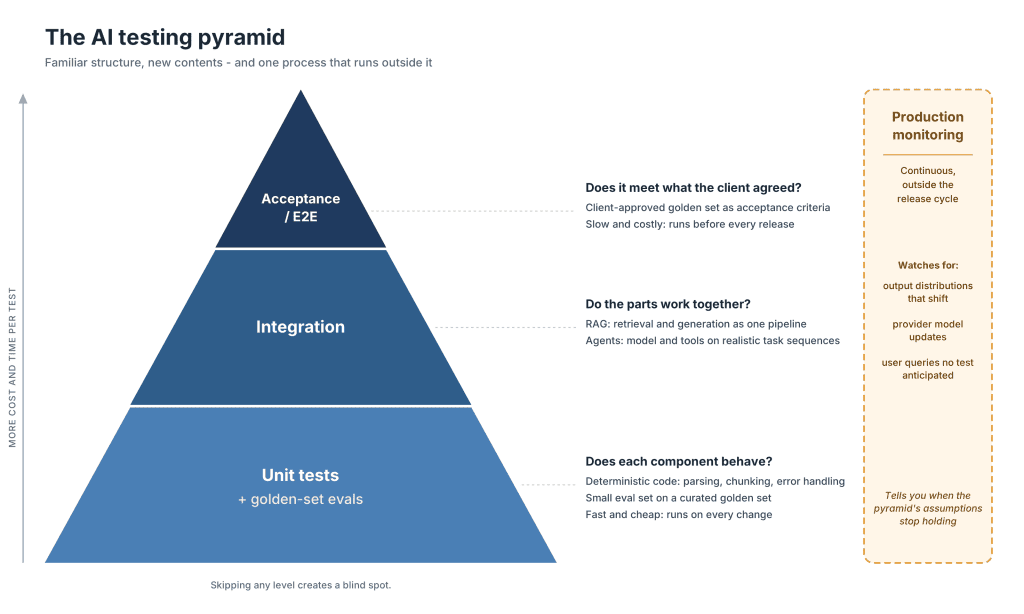
The pyramid is still a useful mental model: many fast, cheap tests at the bottom, fewer slow, expensive ones at the top. That logic survives the move to AI. What changes is what each level contains, and one important element sits entirely outside the pyramid.
Unit tests and golden-set evals: does each component behave?
Unit tests cover the deterministic code: data processing, chunking logic, response parsing, error handling. Alongside them sits a layer specific to AI: a small set of model evals on a curated golden set. They do not replace unit tests. They are a different kind of check on a different kind of component.
Integration: do the parts work together?
Integration tests verify that components work together. In a RAG system, that means retrieval and generation tested as one pipeline. In an agent system, the model and its tools tested together across realistic task sequences. This is where interaction effects appear: behavior that passes component tests but breaks when the components have to coordinate.
Acceptance and end-to-end: does it meet what the client agreed?
End-to-end tests cover the full system from the user’s perspective. In AI, this maps directly to acceptance testing: does the system handle the range of scenarios the client agreed to treat as success? Here the golden set, concrete input and output examples approved by the client, works as the acceptance criteria. This layer is slow and relatively expensive, so it runs before releases, not on every commit.
Production monitoring: outside the pyramid
It is not a test level but a continuous process, independent of the release cycle. Output distributions shift, model behavior evolves, user queries change in ways no test suite anticipated. Monitoring does not replace the pyramid; it tells you when the pyramid’s assumptions have stopped holding.
Skipping any level creates a blind spot. The question is not whether you can afford all of them. It is which blind spot you are choosing to live with.
The failure modes that actually matter
Hallucinations get most of the attention, and they belong on this list. But in production, three quieter failure modes often do more damage, precisely because nobody is looking for them.
Prompt regression. A small prompt change or a provider model update breaks behavior that used to work. Nothing errors. The system runs and simply answers worse on cases that were fine last week. Without versioned prompts and an automated regression suite, nobody sees it until a user does.
Narrow metrics. The tests pass because they measure the wrong things. The format is correct, latency is within bounds, and answer quality is drifting down because nobody defined “good” in a way that can be checked automatically.
Missing baseline. Without a reference point, every “is the new version better?” decision rests on gut feeling and a few cherry-picked examples. The team is not deciding badly; it simply has no data to decide well.
Hallucinations. The model states something plausible and false. Once spotted, a hallucination is obvious; the problem is spotting it at scale.
The first three stay invisible until they are not, and by then the damage is done. Hallucinations are visible when they surface, but without deliberate checks, you rarely catch them at scale. Either way, process is the only protection.
What an AI testing strategy should include
A production-grade AI testing strategy combines several layers. None of them is enough on its own; each closes a gap the others leave open.
1. A golden set agreed with the client. A few dozen real inputs paired with expected outputs, approved by the business owner. It is your baseline, your acceptance criteria and your regression suite in one. Without it, every other layer measures against nothing.
2. Versioned prompts and automated evaluation on every change. Treat prompts and model versions like code: every change goes through review and triggers the evaluation suite against the golden set. This is what catches prompt regression before a user does.
3. Metrics that reflect what the business cares about. Format and latency are necessary but not sufficient. Combine deterministic checks (structure, required fields), model-graded checks (relevance, completeness, tone) and regular human review of a sample. If “good” cannot be checked automatically, define it until it can.
4. Grounding checks. For any system that answers from your data, verify that answers are supported by the retrieved sources, that citations say what the answer claims, and that the system admits when it does not know.
5. Evaluation matched to the architecture. Retrieval measured separately from generation. Agents evaluated on their traces, not just their final answers. Tool use tested together with the model, not only as an interface.
6. Release gates with thresholds. Agree in advance what share of golden-set cases must pass, and what happens when results fall below it: block the release, roll back, or escalate. A threshold nobody acts on is decoration.
7. Production monitoring with a named owner. Sample real outputs regularly, review them against the same criteria, and track drift over time. Someone specific owns model behavior in production, and has the budget to keep evaluating it.
8. Adversarial Testing. For customer-facing systems, deliberately try to break the system: jailbreaks, prompt injection, attempts to extract commitments or confidential data. Users will try; better that you do first.
When the system type changes, so does the testing strategy
A plain language model, a retrieval-augmented system, an agent, and an external service integration have different architectures and different failure modes. The testing strategy has to match the architecture.
Retrieval-augmented systems
The most common mistake is tuning the generation layer before measuring retrieval. If retrieval does not return the right documents, no amount of prompt engineering will produce correct answers. The retrieval pipeline needs its own evaluation, with its own metrics, before the model ever sees the retrieved content. You cannot judge generation when you do not know what went into it.
Agent systems
The final output is a misleading thing to test. An agent can reach a correct conclusion through a flawed path, and it can fail for reasons invisible in the output: an error three steps back that cascades forward silently. Testing agents means testing the trace: the sequence of decisions, tool calls, and intermediate states behind the output. A system that is right occasionally by coincidence isn’t reliable.
External service integrations
Two different things get conflated here. One is whether the integration works as an interface: schema, authentication, error handling. The other is whether the model uses it correctly: whether it understands what the integration offers, when to call it and how to interpret what comes back. Both matter, and neither substitutes for the other.
The counterintuitive part: a model may never call a tool not because the tool is broken, but because its description is too vague for the model to know when it applies. The integration passes every test. The feature never works. This only shows up when you test the model and the integration together.
The part nobody talks about: validating with the client
Everything so far is primarily a technical problem. This one is organizational, and in my experience it sinks more AI projects than model quality does.
The pattern is familiar to anyone who has delivered AI systems to enterprise clients. The team builds something that works. They show it. The client says some version of “this is not what we meant.” The conversation that follows is expensive, confusing, and often corrosive to the relationship. And it was almost entirely preventable.
The root cause is almost never that the team built the wrong thing. Instead, “the right thing” was never specified in a way that could be checked. A written requirements document specifies behavior in language. Language is ambiguous. Two people reading the same sentence about what an AI system “should” do will form different mental models of what that looks like in practice.
Expecting clients to fully specify what they want before seeing it structurally mismatches how AI systems actually work. The question is whether you design your process for this reality or keep getting surprised by it.
Designing for it means building alignment around concrete examples rather than written descriptions. It means calibrating expectations before every significant demo, rather than letting a single bad output define the client’s perception of the system. It means separating the technical review – does the system perform according to measurable criteria – from the business review – does the system deliver value in the client’s actual workflow. These are different conversations that require different participants and different preparation.
It also means having a clear protocol for when the client changes direction after seeing the system. This happens. In AI projects, it is more likely than not. The question is whether a change in client expectations triggers a structured process – classify, document, decide – or a chaotic scramble to accommodate feedback that nobody fully understands.
A more honest definition of “done”
The hardest shift in AI engineering is accepting that “done” is not a stable destination. A software module is done once it’s tested and shipped, until someone changes the code. An AI system that performs well today may perform worse in three months because the underlying model changed, the inputs shifted, or the retrieval data went stale.
This does not mean the work never ends. It means it changes shape. Deployment isn’t the end of quality work; it’s the start of a different kind. Teams that build reliable AI systems design for this from the start: monitoring that surfaces degradation before users report it, clear ownership of the model in production, and a shared understanding with the client of what “the system is working” means over time.
The instincts that make good software engineers still make good AI engineers. Test early. Test continuously. Define what correct looks like before you build. Keep changes small and traceable. Have a rollback plan. What is new is how you apply them to systems that are probabilistic, externally dependent and able to degrade without producing a single error.
The most important change is not technical. It is epistemological. You stop asking “does it work?” and start asking “how often, under what conditions, and how would I know if that changed?” Teams that make that shift build systems that hold up. Teams that do not keep shipping things that worked in the demo.