Table of contents
As an OpenAI services partner, we work closely with its teams and test new capabilities through early access, giving us a practical view of how the platform is evolving. What interests us most is how those changes translate into the enterprise projects we deliver: how agents integrate with existing systems, operate reliably, and justify their costs at scale.
We look at DevDay 2026 through that lens, asking which capabilities large organizations can build on, which still need testing, and where teams should retain control as they plan for 2027.
Table of contents
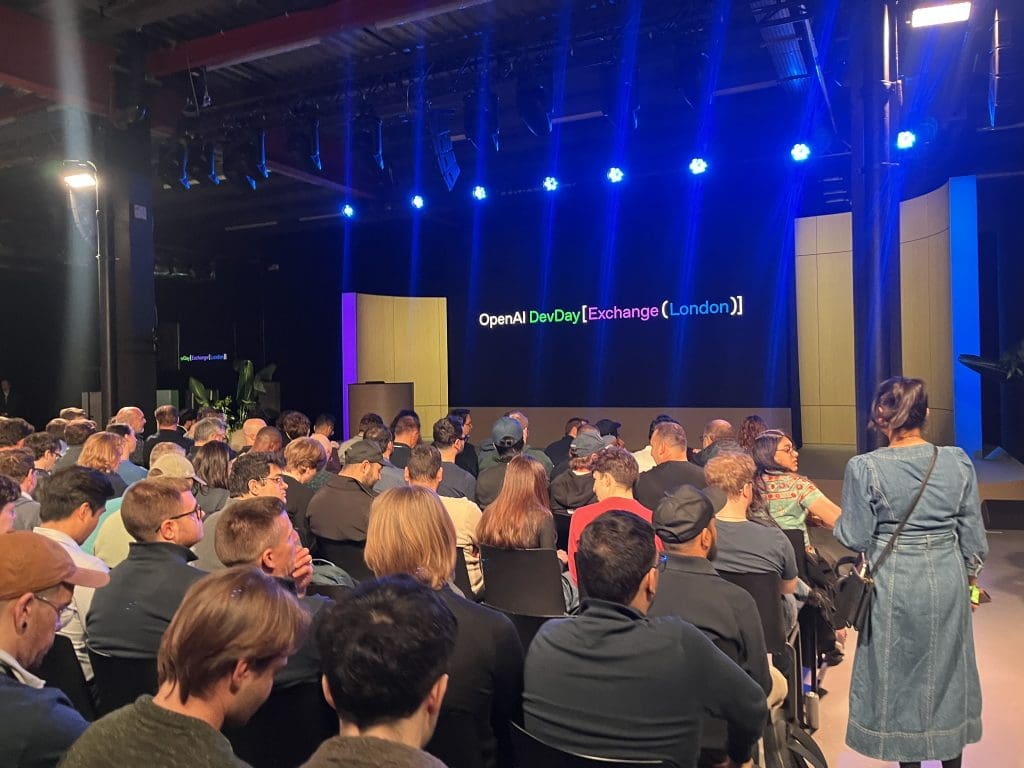
These questions also shaped our conversations with OpenAI’s EMEA and Agents API teams at DevDay Exchange in London. We brought lessons from testing the Agents SDK execution layer and the Agents API, co-writing an OpenAI Cookbook guide on agent evaluation, and moving client agents from prototype to production.
Drawing on that work, we examine what the platform changes mean for enterprise architecture, reliability and cost, and what is worth testing before committing to your next deployment.
TL;DR: Lessons from Enterprise Agent Projects
Looking at OpenAI’s DevDay announcements through the lens of our enterprise projects, five practical considerations stand out for your next deployment: evaluation, failure recovery, architecture, integrations and cost.
- Evaluate agents where they will run. On the same 108-question dataset, one model’s pass rate rose from 74% to 88% in the production harness, while another’s fell from 64% to 43%. Model selection and release decisions need evidence from the configuration you intend to deploy.
- Test what happens when execution stops halfway. Before adopting an agent runtime, verify whether completed actions can be identified, interrupted work can resume safely, and retries avoid duplicating external actions. Managed infrastructure still needs workflow-specific failure testing.
- Architecture improvements can reduce execution overhead. In a supply-chain deployment, a shared agent platform with discoverable tools and integrations used 75% fewer tool calls per question and now handles hundreds of requests a day. Adding use cases no longer requires redesigning the core.
- Reusable integrations can outlast product changes. An MCP server connecting ChatGPT to Microsoft Fabric remained usable as the surrounding product evolved. This illustrates the value of keeping enterprise integrations separate from the user interface, with explicit access controls.
- Reassess costs at the workflow level. Lower model prices are a reason to revisit a business case, but the useful measure is cost per successfully completed task, including tool use, retries and human review.
Four Changes in OpenAI’s Agent Stack to Consider for 2027
For organizations building enterprise agents, four developments from DevDay 2026 deserve a closer look: persistent agents, managed runtimes, ChatGPT-based integrations, and changes in cost and latency. The table below connects each to a planning decision, while distinguishing available capabilities from those still in beta, preview or proposal.
| Shift | What OpenAI announced | What it changes for your organization |
| Persistent agents | Dots: always-on agents with their own cloud computer and plugin access to thousands of apps; specialist dots in enterprise preview. ChatGPT Space as a shared workspace for teams and agents. | Agents become long-lived workers, not chat sessions. You need agent identity, scoped permissions, audit trails and clear ownership of what each agent is responsible for. |
| Managed agent runtime | Agents API has been in public beta since 10 September, with computer use, multi-agent capabilities, tool search and context compaction. Decisions API for fast routing. Bedrock Managed Agents runs the same runtime inside AWS. | Less infrastructure to build and maintain. The decision shifts to which runtime fits your cloud, data residency and governance requirements. |
| ChatGPT as a platform | Plugins extend ChatGPT and Codex; the proposed MCP Events specification lets them start automations from events; Sites and Sign in with ChatGPT. | Your employees’ AI front end may already be decided. The work moves to MCP servers, access control and event-driven workflows behind it. |
| Cost and speed | GPT-6.1 Sol for agentic work at a fifth of GPT-6 Astra’s token price; a paid Ultrafast tier and lower API latency. | Use cases rejected on cost a year ago deserve a second look. Measure cost per outcome, not per token. |
Not all of this is production-ready today: several pieces are in beta, preview or, in the case of MCP Events, still a proposal. That is exactly why planning now pays off. Teams that prepare their architecture during the beta phase adopt at general availability instead of starting there.
Build Integrations You Can Reuse as the Platform Evolves
Changes in OpenAI’s product lineup raise a practical question: how much of your implementation will remain useful when the surrounding platform changes?
In one enterprise project, an MCP server connecting ChatGPT to Microsoft Fabric remained usable as the interface evolved from connectors to apps and then plugins. Keeping the integration separate from the user interface helped preserve that work.
Agent Builder’s move to legacy status raises a related consideration: before adopting a workflow builder, assess how you would migrate its logic, integrations and evaluation tests. This does not make low-code unsuitable for production, but it makes control over state, recovery and testing important selection criteria.
| Announced at DevDay 2025 | Where it is in 2026 | Verdict |
|---|---|---|
| Apps SDK: apps inside ChatGPT, built on MCP | Folded into ChatGPT plugins, alongside skills and MCP servers | Evolved |
| Codex: GA, Slack integration, Codex SDK | Part of the unified ChatGPT platform; its harness also powers the Agents API | Evolved |
| Agent Builder: visual, drag-and-drop workflows | Listed under legacy APIs, with a migration guide | Dropped |
For 2027 planning, identify which parts of your agent stack depend on a specific product and what replacing it would require. Documented interfaces, reusable integrations and workflow logic your team can maintain can help limit the scope of future migrations.
Testing New Capabilities Before They Become Architecture Decisions
Early access lets us test new capabilities against enterprise workflows before recommending where they belong in a client’s architecture. We can examine what the platform handles, where additional engineering is needed, and which limitations could affect integration, reliability or operating costs. That gives clients a stronger basis for deciding what to adopt, what to validate further, and what to defer.
Our tests of OpenAI’s Agents SDK execution layer and Agents API focused on that boundary. We examined how workflows preserve state, pause for approval and recover from interruptions, alongside the diagnostics and cost visibility needed to operate them. The examples below show what we tested and the questions those tests raised for deployment.
Agents SDK: Testing State, Approvals and Resumable Execution
Before the 15 April release, we tested sandboxed execution, persistent state and resumable runs. It behaves less like a chat agent and more like a restartable workflow engine: a run can pause for human approval and resume later, with a full audit trail. We also flagged what was not yet production-default, including high-level multi-agent parallelism and documentation depth.
Agents API: Testing Recovery and Operational Visibility
Before the 10 September public beta, and as part of OpenAI’s launch announcement, we ran multi-step workloads on it: a clinical-trial protocol synopsis workflow, synthetic insurance claims, recovery from a faulty software release and presentation creation from a brand brief. Our feedback focused on the operational layer: session recovery, safe retries, tool-call correlation, cost attribution and self-hosted deployment. By the end of early access, most of it had been addressed or had seen substantial progress.
That work has shaped principles we bring to every client engagement.
First, three questions to ask of any agent platform before you commit to it:
- If execution stops after an external action, can you tell whether the action completed?
- If a session resumes, which steps are safe to run again?
- Can an operator tell failed, still-running and completed-but-interrupted work apart?
Harness-Aware Evaluation: Testing in the Production Environment
Second, test results depend on where the agent runs. In Harness-aware evaluation of plugins, the same 108 questions gave very different results in a test loop and in the real Codex harness:
| Harness | GPT-6 Luna | GPT-5-mini |
|---|---|---|
| Standalone test loop | 0.74 | 0.64 |
| Product harness (Codex) | 0.88 | 0.43 |
A 10-point gap in testing became 45 points in the product. A team choosing the cheaper model on test-loop results would have shipped a plugin that fails most questions. Across repeated runs, 21% of answers also flipped between pass and fail. As OpenAI moves more agents into ChatGPT and Codex, evaluating in the harness that ships becomes a release requirement, not a nice-to-have.
Applying the OpenAI Agent Stack to Enterprise Workflows
The runtime and evaluation questions above become concrete when agents connect to business systems and support everyday work.
Three client projects illustrate the decisions involved: consolidating supply-chain prototypes into a shared platform, connecting ChatGPT to governed enterprise data, and developing an expense-reporting PoC into a production MVP. They show how architecture, integration and access controls shape the path to deployment, with the third project still in development.
1. From Agent Prototypes to a Platform
A global agricultural machinery manufacturer had several supply-chain agent prototypes that were becoming impossible to maintain. After an advisory phase on architecture, evaluation and observability (January–March), we built one platform on the Agents SDK by June. A modular extension framework makes tools, skills, knowledge sources and integrations discoverable, so new use cases do not require redesigning the core.
Results: time to first token down, 75% fewer tool calls per question, hundreds of requests a day in production. Because it sits on the Agents SDK, the platform is positioned to adopt the managed runtime rather than rebuild for it.
2. ChatGPT Connected to Enterprise Data
In January and February, we built an MCP server on Azure connecting ChatGPT to a spirits producer’s Microsoft Fabric data, with OAuth and access limited to approved datasets. It shipped as a ChatGPT connector; the product has since been renamed twice, to apps and then plugins, and the MCP server did not need to change.
3. From PoC to ChatGPT Plugin
For a logistics real estate company on ChatGPT Enterprise, we built a 3-week expense-reporting PoC covering receipt extraction, policy validation and process Q&A. We are now turning it into a production MVP: a ChatGPT plugin connected via MCP to Snowflake through Dataiku.
How to Prepare your 2027 agent Roadmap
Based on what OpenAI announced and what we have seen in production, these are the moves we recommend making in the next two quarters:
- Review pilots against business and deployment requirements. Identify where a managed runtime could reduce operational work and where ChatGPT fits users’ existing workflows. Retain, redesign or stop pilots based on their value, reliability and integration requirements.
- Consolidate where agents share common needs. When several use cases need the same tools, data access, evaluation or monitoring, a shared foundation can reduce duplicated work. Let those recurring requirements determine the scope of the platform.
- Use MCP where it supports your integration strategy. For workflows connecting ChatGPT or other MCP-compatible clients to internal systems, assess whether reusable MCP servers simplify access and maintenance. Define authentication, permissions and ownership alongside the integration.
- Set boundaries for persistent agents. Define agent identities, access scopes, approval requirements and audit ownership. Specify when an agent must stop or escalate, particularly when actions change business systems.
- Make evaluation in the deployment harness a release gate. Use lightweight test loops during development, then validate the intended model, tools, prompts and permissions together. Repeat runs to measure consistency and test failure recovery before release.
- Revisit the economics of complete workflows. Measure cost per successfully resolved case, reviewed document or answered request, including model usage, tools, retries, human review and ongoing operation. Reassess previously rejected use cases where these costs or achievable quality have materially changed.
Prepare for the platform, not the announcement
OpenAI’s evolving agent stack gives enterprise teams more options for running workflows and connecting them to existing systems. For your 2027 roadmap, the practical task is to establish where those capabilities meet your requirements and where your team still needs to build, test and maintain the solution.
Whether you are shaping an enterprise agentic AI program or scaling existing initiatives, we help connect business priorities with the architecture, integration, evaluation and governance needed to put agents into production.