Table of contents
OpenAI has launched the OpenAI Partner Network, and we are proud to announce that deepsense.ai has been named an OpenAI Advanced Partner within the OpenAI Partner Network.
“We’re pleased to welcome deepsense.ai as an OpenAI Advanced Partner. The deepsense team brings practical enterprise AI delivery experience across strategy, implementation, and adoption,” said Philip Larson, Senior Director, OpenAI Partner Network. “Through the OpenAI Partner Network, deepsense.ai can help more enterprises move from AI pilots to measurable business impact.”
The OpenAI Partner Network is a global program for partners to build, sell, and deliver AI solutions with OpenAI. It brings together partners with deep industry expertise, delivery capabilities, and customer relationships, while equipping them with resources, enablement, and support to help enterprises adopt OpenAI frontier models and products and achieve measurable impact.
“Our collaboration with OpenAI began in late 2024, soon followed by our first joint client delivery. In under two years, we joined the inaugural cohort of OpenAI Services Partners and began supporting Fortune 500 companies — reflecting the trust and momentum behind the relationship. Advanced Partner status marks the beginning of the next exciting chapter as we set out to help more organizations move from isolated experiments to production-grade AI systems — faster, at greater scale, and with measurable results.”
– Adam Gorniak, CEO at deepsense.ai
Enterprise AI requires more than access to frontier models
For enterprise AI leaders, access to powerful models is no longer the primary challenge.
The harder part is deciding where AI can create meaningful value, integrating it securely with enterprise data and systems, redesigning workflows, evaluating performance under real operating conditions, and scaling adoption across the organization.
A successful demo may prove that a model can complete a task. A production system must also address:
- output quality and consistency,
- access control and data governance,
- retrieval accuracy and context management,
- latency and infrastructure cost,
- observability and evaluation,
- failure handling and human oversight,
- integration with existing tools and workflows,
- adoption and measurable return on investment.
The OpenAI Partner Network is designed to help organizations close the implementation gap in enterprise AI adoption by combining OpenAI technology with the strategy, engineering, integration, and deployment expertise of trusted partners.
What the OpenAI Advanced Partner status means
The OpenAI Partner Network includes three tiers: Select, Advanced, and Elite. Progression within the network is based on areas such as technical capability, deployment experience, sales performance, and collaboration with OpenAI.
As an OpenAI Advanced Partner, deepsense.ai can build on closer technical and commercial collaboration with OpenAI while continuing to support clients throughout the complete AI delivery lifecycle. This includes using GPT-5.6 to solve harder problems with greater intelligence and efficiency, while helping teams use ChatGPT Work to move beyond isolated interactions and support complex, multi-step workflows that produce finished work.
For our clients, this means a stronger path from initial AI strategy to reliable deployment.
From isolated copilots to operational AI systems
The first challenge is rarely generating a list of potential AI use cases. The real challenge is identifying which use cases are technically feasible, economically justified, and important enough to scale.
We help organizations evaluate opportunities based on business value, data readiness, implementation complexity, operating risk, and expected ROI. Selected initiatives can then move through architecture, validation, integration, deployment, and optimization without being handed between disconnected vendors.
Production-grade architecture and engineering
Enterprise AI systems must operate within real technology environments rather than isolated sandboxes.
Our teams design and build solutions that connect OpenAI models with internal data, APIs, applications, identity systems, and operational workflows. This includes helping organizations apply GPT-5.6’s stronger reasoning and efficiency to production use cases and configure ChatGPT Work around the company context, connected tools, controls, and approval points required for complex enterprise workflows. Depending on the use case, this may also include agentic architectures, RAG pipelines, custom connectors, evaluation frameworks, guardrails, orchestration layers, monitoring, and deployment infrastructure.
The objective is not simply to produce a working response. It is to create a system that remains reliable, maintainable, secure, and cost-efficient as usage grows.
Evaluation before and after deployment
AI quality cannot be managed through occasional manual testing.
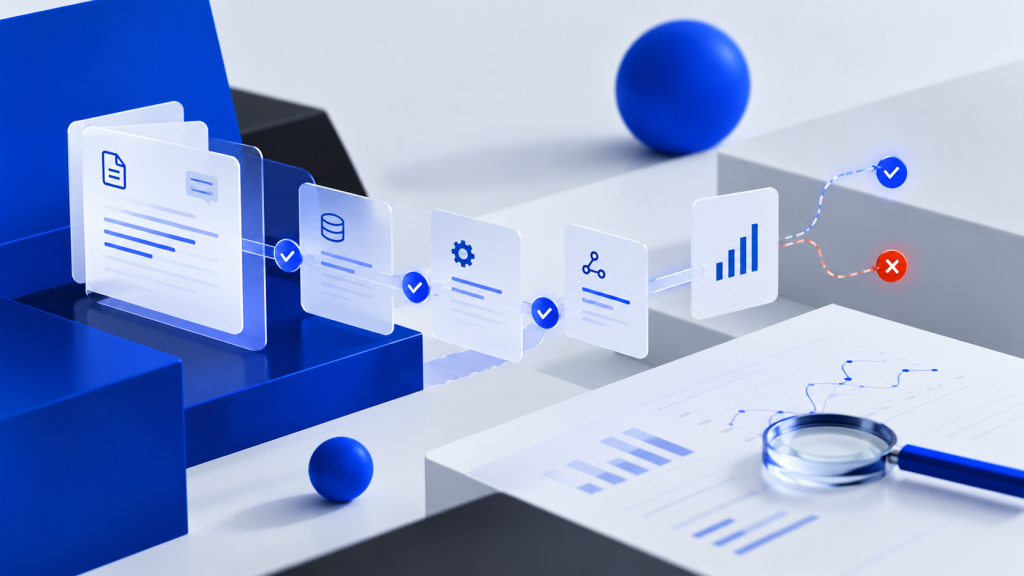
Production deployments require explicit evaluation criteria covering factors such as task completion, factual accuracy, retrieval quality, consistency, safety, latency, and cost. They also require monitoring that can detect regressions when models, prompts, data sources, or workflows change.
Evaluation is therefore part of the system architecture—not a final check performed before launch.
A clearer connection between AI and business outcomes
Enterprise AI programs need more than technical metrics.
For every implementation, the relevant business outcome may be different: reduced handling time, greater employee capacity, faster knowledge retrieval, improved conversion, lower operational cost, higher-quality decisions, or new product revenue.
Establishing these measures early helps organizations prioritize investments, compare solutions, and determine whether a use case should be scaled, redesigned, or discontinued.
The next stage of our collaboration with OpenAI
Becoming an OpenAI Advanced Partner strengthens our ability to help clients move from AI ambition to systems that work reliably in production.
It also aligns closely with how we have approached AI delivery from the beginning: focus on high-value use cases, apply deep technical expertise, engineer for real operating conditions, and measure success through tangible outcomes rather than the number of completed proofs of concept.
Organizations looking for implementation support can also discover deepsense.ai through the OpenAI Partner Locator, which helps enterprise customers identify partners suited to their AI objectives.
We are excited to continue working with OpenAI and our clients to design, build, and scale the next generation of enterprise AI systems.
Explore our approach to building and deploying enterprise-ready OpenAI solutions.
Table of contents